

 |
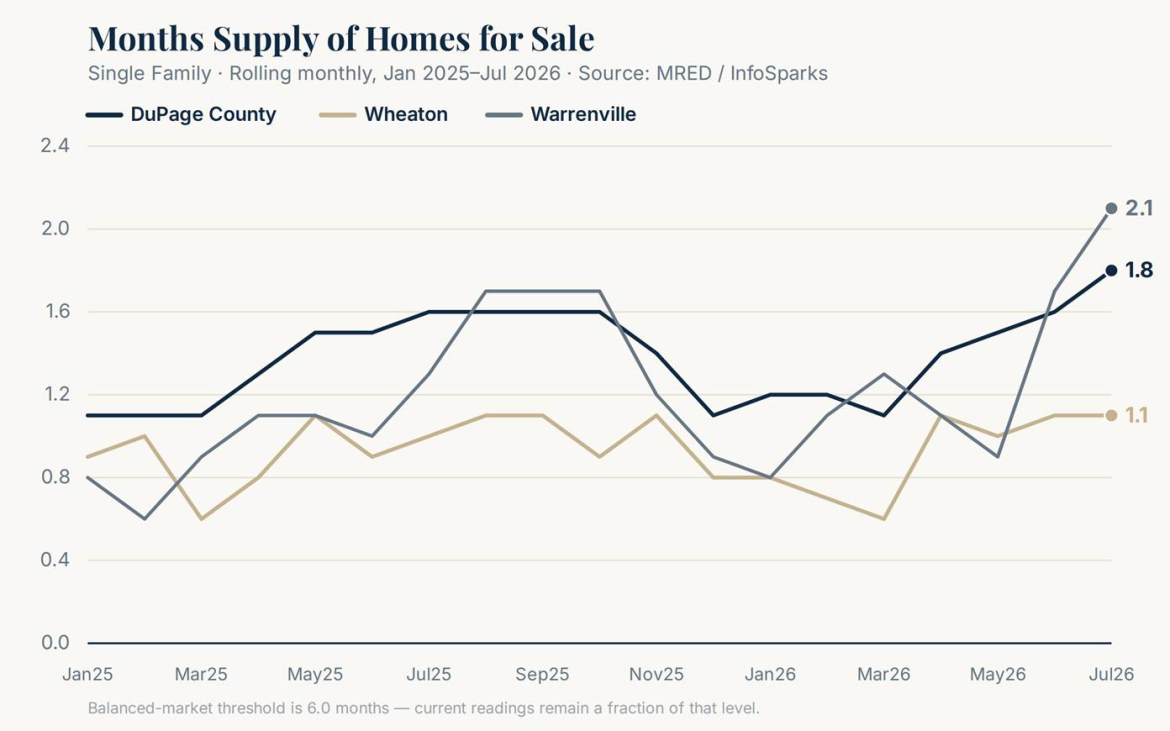
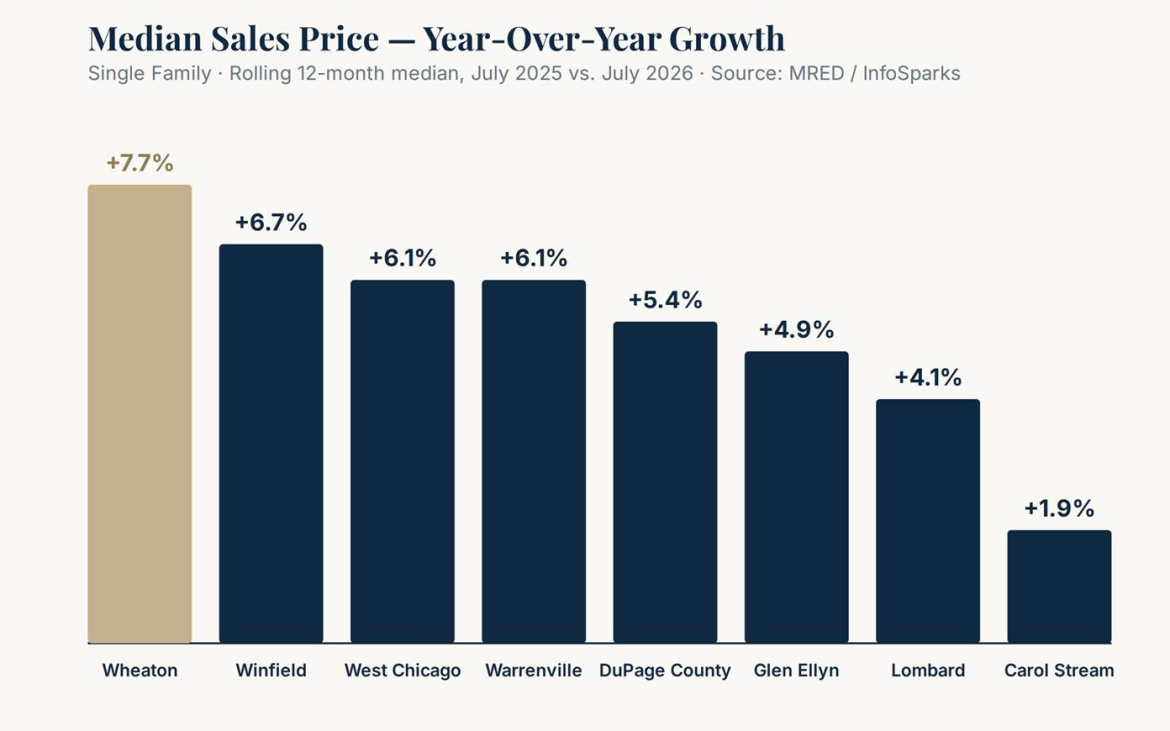
| Every summer, "inventory is finally opening up" becomes a headline. This year it’s technically true — and it still doesn’t mean what people think it means. For the first time in nearly two years, DuPage County’s months of supply has made a sustained climb — from 1.1 months in January to 1.8 in July. That’s real. It’s also still less than a third of the 6.0-month mark that defines a balanced market. If you’ve been waiting for that number to translate into price relief, more negotiating room, or a slower pace, the corridor data says otherwise. Sellers are still getting full asking price or better. Homes are still moving in one to two weeks. And in Wheaton, the corridor’s tightest market, prices grew faster over the past year than anywhere else in our footprint. |
 |
| Inventory Is Loosening — Here’s What That Actually Means Start with the honest version of the story: supply is up. DuPage County’s months of supply bottomed out at 1.1 in both January 2025 and January 2026, then climbed through the spring and summer to 1.8 in July — the highest countywide reading in the trailing 19 months. Warrenville moved even more sharply, from 0.9 months in December to 2.1 in July, more than doubling in seven months. |
 |
|
That is a genuine loosening trend, and it will get reported as such. But context matters: a "balanced" market — one where buyers and sellers have roughly equal negotiating power — sits at 6.0 months of supply. Even Warrenville’s 2.1 months, the loosest reading anywhere in our corridor this year, is barely a third of the way there. Wheaton, by contrast, has barely moved: it closed July at 1.1 months, almost exactly where it started 2025. The practical read for the corridor’s move-up owners: if you’ve been holding off on listing because you assumed rising inventory meant more competition for sellers, the math doesn’t support that yet. You’re still selling into a market where supply is a fraction of what balance requires. Prices Aren’t Blinking If looser supply were actually cooling the market, we’d expect to see it show up in three places: prices, sale-to-list ratios, and days on market. None of the three has moved. |
Sale-to-list ratios tell the same story. Across every town we track, the median percent of original list price has sat at or above 100% in nearly every month of 2026 — meaning the typical seller is still getting full asking price or a bidding-war premium, not a discount. Market times back it up: July’s medians ran 7 to 12 days across the corridor, squarely in the range we’ve seen since spring, with no lengthening despite the extra inventory. |
 |
The Bottom Line DuPage’s inventory thaw is real, but it’s a thaw — not a reversal. Months of supply climbing from 1.1 to 1.8 is meaningful movement inside a still-scarce market, not the start of a buyer’s market. Prices, sale-to-list ratios, and market times all confirm the same thing: sellers still hold the leverage across every town in the corridor, and Wheaton—the tightest market of all—posted the fastest price growth to prove it. Add in a bond market that’s currently pricing real uncertainty around the Fed’s next move rather than the rate relief many buyers are still banking on, and "wait and see" remains the riskier position on both fronts this fall. Corridor Watch Quiet but active behind the scenes this week: an unsigned listing conversation underway in Winfield for a move-up family eyeing the fall market, and a pre-listing consult booked in Glen Ellyn for a property that’s likely to test the upper end of that town’s price-per-square-foot range. More to share once ink is dry. This Week in DuPage
|
 |